The Short Answer
A phenakistoscope (also spelled phenakistiscope or phenakistiscope) is one of the world's first animation devices. Invented in 1832, it uses a spinning disc printed with sequential images to create the optical illusion of a looping, moving animation. It predates cinema by over 60 years.
History of the Phenakistoscope
The phenakistoscope was invented simultaneously and independently by two people in 1832: Joseph Plateau, a Belgian physicist, and Simon von Stampfer, an Austrian mathematician. Both published their designs within weeks of each other.
The name comes from the Greek phenakizein (to deceive or cheat) and skopein (to look at), literally "the deceiving viewer." The device was a commercial sensation in the 1830s, selling as a parlor toy across Europe.
It was one of the key precursors to the zoetrope, the flip book, and ultimately the motion picture camera. Many historians of film trace the origin of cinema to this spinning disc.
How Does a Phenakistoscope Work?
The phenakistoscope exploits a visual phenomenon called persistence of vision, the tendency of the human eye to retain an image for a fraction of a second after it disappears. When images flash past rapidly enough, the brain blends them into smooth motion.
The original device works like this:
- A disc is printed with a series of sequential images arranged around its edge (like frames of an animation).
- Slots are cut between each image.
- The viewer holds the disc up to a mirror and spins it.
- Looking through the slots, each image is visible for just a fraction of a second, and the slots act as a shutter, stopping the blur between frames.
- The result: the images appear to move in a seamless loop.
Phenakistoscope vs. Zoetrope vs. Praxinoscope
These are all early animation devices from the same era, each a variation on the same idea:
- Phenakistoscope (1832): spinning disc viewed in a mirror through slots. One viewer at a time.
- Zoetrope (1834): cylindrical drum with strips of images. Multiple viewers at once.
- Praxinoscope (1877): improved zoetrope using mirrors instead of slots for a brighter image.
- Flip book (1868): sequential images on pages, flipped rapidly with a thumb.
What Does a Phenakistoscope Look Like?
Here are examples of phenakistoscope-style animations created with PhenaSpin, each a still image transformed into a spinning looping animation. You can find more in the full template gallery.
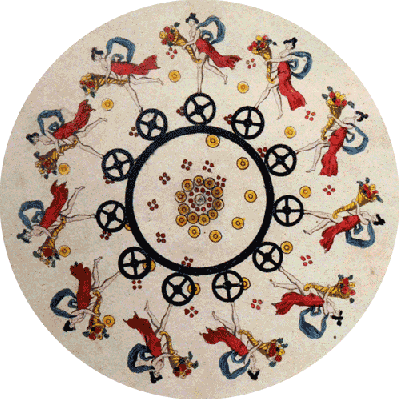
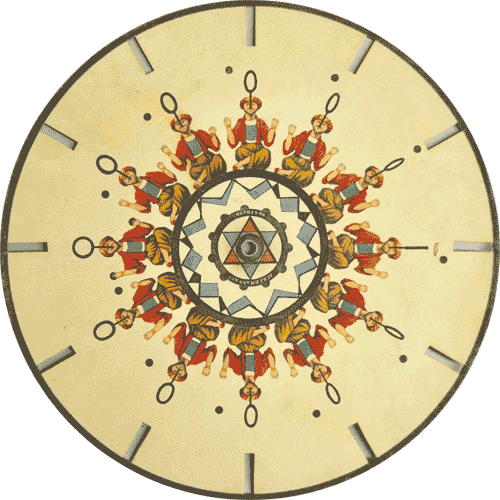
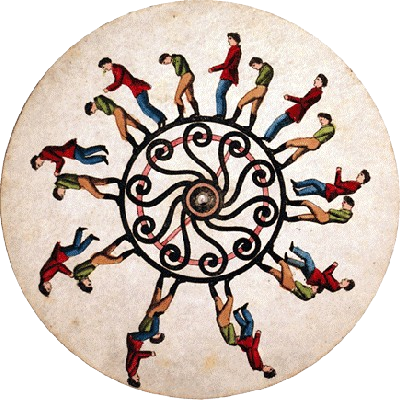
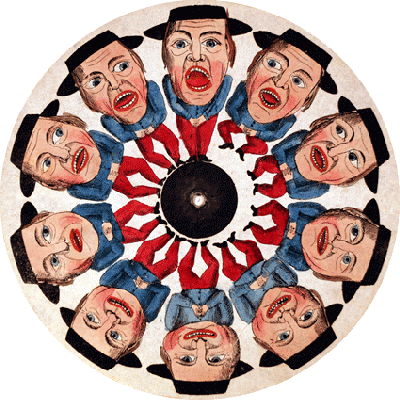
What is a Phenakistoscope Used for Today?
Today, phenakistoscope-style animations are popular in digital art, motion graphics, and social media content. The distinctive looping, spinning aesthetic (sometimes called a phenascope or phenospin effect) is used by artists and creators to transform still images into hypnotic animated videos.
Modern digital phenakistoscopes don't require a physical disc or a mirror. Tools like PhenaSpin let you upload any image, apply the spinning effect digitally, and export the result as an MP4 video to share anywhere. Related: Zoetrope animation maker.
Make Your Own Phenakistoscope. Free, Online, Instantly
Upload your image to PhenaSpin. Customize the spin speed, direction, and frame count. Export as MP4 in seconds. No account, no download required.
Try PhenaSpin Free →Frequently Asked Questions
How do you pronounce phenakistoscope?
It's pronounced feh-NAK-ih-stoh-scope. The word comes from Greek: phenakizein (to deceive) + skopein (to look at).
What image should I use for a phenakistoscope?
For a seamless loop, use a phenakistoscope disc image with evenly divided radial sections and set the frame count to match the section count. Mandalas and circular designs also tend to produce striking results. Other images can create interesting spinning effects, but the loop may not be seamless.
What is the difference between a phenakistoscope and a GIF?
A GIF plays frames in a linear sequence. A phenakistoscope spins the image itself; the rotation creates the animation. The result feels more organic and hypnotic than a standard GIF loop. PhenaSpin exports as MP4, which gives much better quality and smaller file sizes than GIF.
Is PhenaSpin free to use?
Yes, the core tool is completely free. You can upload images, customize settings, and export MP4 videos with a watermark at no cost. A one-time premium upgrade removes the watermark.
What format does PhenaSpin export?
PhenaSpin exports as MP4 video, which is compatible with Instagram, TikTok, Twitter/X, YouTube Shorts, and most other social platforms.